
Affiliate Disclosure: We may earn a commission from a qualifying Mangools link in this article, at no extra cost to you. Other products are not ranked by commercial relationship. This comparison uses public product information and does not claim hands-on testing without displayed evidence. See our editorial policy.
Focused workflow option
Need research and rank tracking—not a full technical crawler?
Mangools may be a sensible finalist for a lean SEO workflow. Read the dated review for plan limits and exclusions, then test your own priority keywords before committing.
Part of our SEO Software Guides and Free Evaluation Tools library.
Decision shortcut
Shortlist faster
Start with the comparison, then use the situation-based picks and final verdict to validate your choice.
Somewhere on your to-do list, probably between "fix the contact form" and "post more on LinkedIn," sits a line that says something like figure out SEO.
And every time you try, you hit the same wall: plans, credits, projects, seats, and promotions make the real annual cost difficult to compare. That is a serious commitment for software you do not yet know how to use, supporting a strategy you may not have defined. So the tab closes and the decision survives another quarter.
Small businesses do not automatically need flagship SEO platforms. The purchase becomes justified when free sources no longer support a repeated decision such as topic selection, technical monitoring, rank tracking, competitor research, or link analysis.
We'll compare the two giants (Semrush, Ahrefs) against three mid-market challengers (SE Ranking, Mangools, Ubersuggest) through a small-business lens: limited time, limited budget, and a site that needs results before it needs dashboards.
Who This Article Is NOT For
- Agencies managing 20+ client sites. Your math is different — API access, white-label reports, and seat pricing dominate the decision. You already know you're buying Semrush or Ahrefs; go compare their agency tiers.
- Pure local businesses (single-location restaurants, salons, dentists). Your SEO is 80% Google Business Profile, reviews, and citations. A rank tracker helps, but tools like BrightLocal serve you better than anything here.
- People seeking a free-only stack should begin with Search Console and appropriate free research or crawling options. Pay only after documenting the limitation that blocks the next decision.


How We Evaluated These Tools (3 Criteria)
1. Time-to-useful-insight
Small business owners rarely have a week for onboarding. Our evaluation therefore gives weight to the shortest path from signup to a useful decision: a keyword worth validating, a fixable site issue, or a competitor gap. Buyers should time this workflow during a trial instead of assuming a broad feature list will translate into regular use.
2. Data you'll actually use vs data you'll pay for
This comparison gives most weight to the core small-business loop: keyword research, rank tracking, technical auditing, and competitor investigation. Database size matters only when the relevant market and workflow produce useful evidence.
3. Honest cost at small-business scale
Not the entry price — the price of the plan you'd actually need, including the limits that force upgrades (tracked keywords, projects, report caps). Entry-tier limits are where this industry hides its real pricing.
The Comparison Table
This table compares the product surfaces a small business should verify, not unstable promotional prices or untested database claims. Plan names, limits, trials, and billing terms change frequently; open the dated official sources below and capture the checkout terms for your own country before buying.
| Semrush | Ahrefs | SE Ranking | Mangools | Ubersuggest | |
|---|---|---|---|---|---|
| Primary shortlist reason | Broad SEO and marketing workflow | Search, content, and link research | SEO workflow with reporting and rank tracking | Focused keyword, SERP, rank, link, and site-metric tools | Keyword, audit, tracking, and content workflow |
| Verify before paying | Projects, users, tracked keywords, reports | Projects, credits, exports, overages | Keyword allowance, update frequency, users, history | Lookups, tracked keywords, rows, users | Daily limits, projects, users, regional terms |
| Technical-audit requirement | Test known issues and crawl allowance | Test known issues and crawl allowance | Test known issues and crawl allowance | Budget for a separate crawler if required | Test known issues and crawl allowance |
| Data validation test | Use the same ten queries, three competitors, known links, and known crawl issues; compare results with Search Console and your source data. | ||||
| Cost comparison rule | Record checkout currency, tax, billing commitment, renewal price, required seats, and the first plan whose limits cover one ordinary month of work. | ||||
The Individual Reviews
Semrush — the everything platform (bring a map)
Semrush presents a broad collection of SEO and marketing workflows. That breadth can consolidate work, but it also increases the importance of testing the exact tasks your team will repeat.
Semrush combines keyword research, auditing, competitor analysis, advertising, content, and other marketing tools. Test the Keyword Magic Tool, Site Audit, and competitor workflow with the same domain and topic set used for every finalist.
Semrush’s breadth can increase onboarding requirements. Time a defined workflow, hide irrelevant projects where possible, and include training and administration in the cost. A large suite is poor value when users cannot complete the repeated task.
One more real consideration: the Pro plan allows just one user seat and five projects. For a single business site, that's plenty. Know the limits before assuming.
Pros:
- Competitor and keyword workflows can be tested in the same product
- True all-in-one: if you also run Google Ads or content marketing, consolidation is real value
- Enormous learning resources (Academy, blog, webinars) included free
Cons:
- The required plan, seats, and billing commitment can create a substantial annual cost
- Interface overwhelm is real; expect a learning curve measured in days
- Many included tools will go completely unused at small scale
Verdict: Choose Semrush if search is a primary growth channel and you (or someone on your team) will invest the hours to use it properly. It rewards commitment and punishes dabbling.
Ahrefs — the specialist's scalpel
Ahrefs emphasizes search and backlink research. Validate Link Intersect, Content Gap, auditing, and rank requirements with a known sample; reputation does not replace a comparison of relevant coverage and limits.
Content Gap and competitor-link workflows can produce topic and outreach candidates, but every candidate requires relevance, intent, quality, and feasibility review before action.
Ahrefs offers a different product structure from Semrush and provides Webmaster Tools for verified sites under current terms. Test learnability, project limits, credits, exports, and the exact paid tier required rather than relying on a subjective interface judgment.
The gripes: Lite-tier limits are tight, and Ahrefs has a history of charging for usage overages in ways that annoy small customers. No meaningful PPC features, if that matters to you.
Pros:
- Link and competitor research are central workflows to test
- A focused search workflow may reduce irrelevant product surfaces for some teams
- Free Webmaster Tools tier for your own site is genuinely useful
Cons:
- Lite plan limits (and credit-based usage) can pinch quickly
- Weak on PPC and broader marketing features
- May exceed the needs of a site focused on a small set of local queries
Verdict: Choose Ahrefs if your strategy depends heavily on content and link research and you value depth over a broader marketing suite.
SE Ranking — the one the listicles underrate
SE Ranking combines keyword research, site auditing, rank tracking, competitor analysis, and reporting at a public price below some flagship suites. The relevant question is not a percentage comparison; it is whether its plan contains the exact database, update frequency, history, export, and reporting capacity your team needs.
Its product scope covers the core small-business workflow, but capability and data quality should be verified with the same keywords, domains, and technical issues used to test every finalist. Time the setup, record lookup consumption, and compare a small sample with Search Console and your existing crawler.
Pricing varies with plan capacity and billing terms. Model the required tracked keywords, check frequency, projects, users, exports, and reporting needs before comparing its checkout total with another finalist.
Do not infer database coverage or historical depth from a feature list. Test a fixed sample of known links, competitors, and queries, and confirm that the reporting and handoff workflow fits the people who will use the output.
Pros:
- Broad SEO workflow can be tested against a defined small-business use case
- Plan capacity can be matched to tracked keywords and update requirements
- Pricing scales with your actual usage instead of forcing big tier jumps
Cons:
- Backlink coverage and history require a controlled comparison sample
- Training, integrations, and handoff requirements should be checked before purchase
- Some advanced features (API, white label) locked to higher tiers
Verdict: Shortlist SE Ranking when you need a broad SEO workflow without flagship pricing, then verify the plan limits with your own project sample.
Mangools — the friendly one
Mangools presents five focused products: KWFinder, SERPChecker, SERPWatcher, LinkMiner, and SiteProfiler. The suite is organized around keyword research, SERP analysis, rank tracking, backlink inspection, and domain-level metrics rather than an expansive marketing platform.
KWFinder combines keyword ideas, difficulty context, trends, and a SERP overview. That concentrated workflow may suit a beginner, but no third-party review can prove ease or metric accuracy for every niche. Test ten real seed topics, compare known queries with Search Console, and record how plan lookups are consumed.
Technical crawling is not one of the five named tools, so buyers who require continuous site auditing should verify the current product set and budget for a separate crawler if needed. Rank, lookup, backlink-row, and site-lookup allowances vary by plan and must be checked on the official pricing page.
Pros:
- Five clearly separated tools cover common keyword, SERP, rank, backlink, and domain-research tasks
- KWFinder puts keyword context and the visible SERP in one workflow
- Official free or trial access can be used to test fit before a paid commitment
Cons:
- The named suite does not center on technical site crawling
- Tracked keywords and lookup consumption must be modeled against the selected plan
- Large-scale competitive or backlink research needs a controlled data sample before purchase
Verdict: Shortlist Mangools if keyword research and rank tracking are the main needs. Read our full Mangools review and test plan, and pair it with Search Console plus a crawler when technical auditing is required.
Ubersuggest — the budget door into SEO
Ubersuggest is commonly considered by buyers who want keyword research, site-audit guidance, rank tracking, and content ideas in one product surface.
Its public offer and regional checkout terms can change, including the availability and scope of longer-term purchase options. Compare the exact amount, renewal or lifetime terms, daily allowances, projects, users, and refund conditions shown in your checkout rather than relying on a copied headline price.
Test the basic workflow with the same queries, known crawl issues, competitors, and tracked keywords used for every finalist. Record where the product changes a decision and where a limit interrupts the work.
The honest caveat is that third-party volume, difficulty, and backlink metrics are estimates. Validate a fixed sample against Search Console, Google Ads data where available, known links, and the same competitor set used for every finalist. Daily lookup limits on lower tiers also need to be tested against the team's recurring workflow.
Pros:
- Keyword, audit, tracking, and content workflows can be tested together
- Guided explanations may reduce the time needed to interpret an issue
- Longer-term purchase options may be available; verify current regional terms
Cons:
- Third-party estimates require validation against first-party data
- Daily limits and backlink coverage require a fixed sample test
- Capacity may need reassessment as projects, users, or research volume grow
Verdict: Shortlist Ubersuggest when its current checkout terms and limits cover your defined workflow, then validate its estimates against Search Console and known source data.
Which One Should You Pick? (By Situation)
- "SEO will be a primary growth channel and I'll invest real hours." → Semrush (broad, all-in-one) or Ahrefs (content/link depth). Take both trials in the same week and keep whichever you opened more.
- "I need rank tracking, auditing, research, and reporting in one SEO workflow." → SE Ranking. Test its exact plan capacity against the same projects and keyword set used for every finalist.
- "I'm new, and keyword research is what I need most." → Mangools. Add Google Search Console for free technical monitoring.
- "I need a guided keyword, audit, and tracking workflow." → Ubersuggest. Verify the current regional offer and daily limits before committing.
- "I haven't exhausted free tools yet." → Then honestly: Google Search Console + Ahrefs Webmaster Tools (both free) first. Come back when you hit their ceiling. The paid tools will still be here.
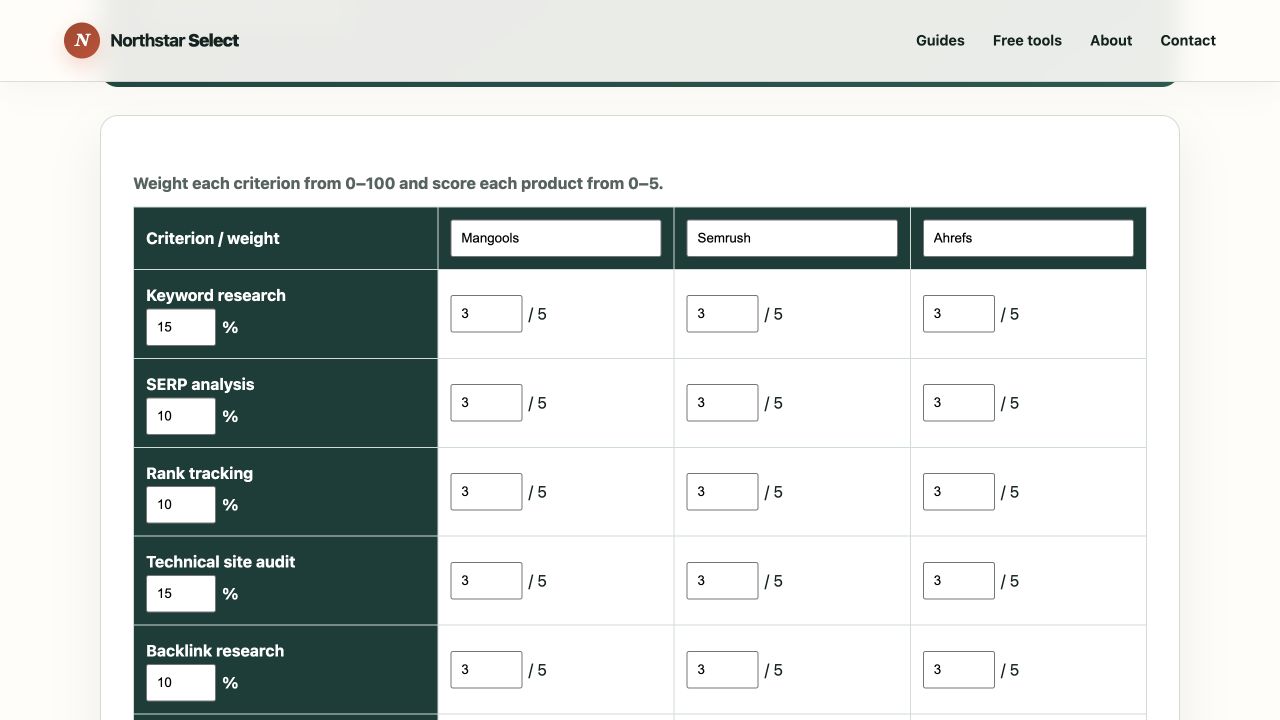
FREE COMPARISON TEMPLATE · NO SIGNUP
Replace our general ranking with your weighted shortlist
A small business that needs daily rank tracking should not use the same weights as a consultant focused on backlinks or a local company buying its first crawler. Score three finalists against one shared evidence set.
Evidence before purchase
Use one fixed SEO validation set
Prepare ten Search Console queries, five known ranking pages, three known technical issues, two competitor domains, and several backlinks you know exist. Apply the same locations, devices, dates, and definitions to every finalist. Third-party metrics are estimates, not Google ground truth.
| Workflow | Evidence | Pass condition |
|---|---|---|
| Keyword research | Relevant ideas, intent, trends, SERP, usage consumed | Five feasible topics survive manual review |
| Rank tracking | Country, device, location, date, ranking URL | Settings match the market being measured |
| Site audit | Known issue detection, false positives, priority | Important issues are actionable and traceable |
| Competitor research | Known pages, links, gaps, export | Candidates are relevant rather than merely numerous |
| Economics | Projects, credits, rows, history, users, reports | Ordinary monthly work fits the selected plan |
Official resources checked
Verify databases, credits, projects, tracked keywords, refresh frequency, history, exports, tax, promotions, and renewal terms immediately before purchase.
The Bottom Line
The SEO tool industry wants you to believe data volume wins. For small businesses, the real currency is acted-upon insights per month — and that depends far more on whether you'll actually open the tool than on whose database is biggest.
Choose a shortlist by required workflow and annual budget, then give every trial the same week-one job: identify and validate five realistic topics or detect and prioritize known technical issues. Keep the product only when the evidence changes a useful decision within the allowed capacity.
Affiliate disclosure: links to Semrush, Ahrefs, SE Ranking, Mangools, and Ubersuggest may be affiliate links; we may earn a commission if you subscribe through them, at no additional cost to you. Rankings and criticism are never influenced by compensation — see our editorial policy. Prices and plan limits verified at publication and change frequently.
Ready to narrow the field?
Use the evidence, then choose for your workflow.
Prices and plans change frequently. Re-check the current offer on the provider’s official website before purchasing. Affiliate links may be added after partner approval and will always be disclosed.
Compare your shortlist with the same criteria
Use the free SEO Tool Evaluation Scorecard to weight ten requirements, score three products, and export the decision as CSV. The calculation runs in your browser.
Frequently asked questions
Which SEO tool should a small business buy first?
Start with free Google tools, then pay for the bottleneck you cannot solve: keyword research, competitor analysis, rank tracking, site crawling, or local SEO. Avoid buying an all-in-one suite before defining the decisions it must support.
Can a free SEO tool be enough?
Yes for a small site focused on basic indexing, queries, and technical checks. Paid tools become useful for broader keyword databases, competitive research, scheduled crawling, historical tracking, and client reporting.
How should I evaluate an SEO tool trial?
Use a fixed test: research one topic, audit known site issues, inspect a competitor, create a keyword list, and export a report. Record data coverage, workflow speed, limits, and whether the results change an actual decision.
Fact-checking note: prices and plan terms can change. Verify current details with the provider before purchasing. Last reviewed August 7, 2026.