
Affiliate Disclosure: Some DomoAI, Vidu, and Wizstar links in this article use an affiliate identifier, which may earn RIA LLC a commission at no extra cost to you. This comparison uses public product information and does not claim hands-on testing without displayed evidence. Our conclusions remain independent, and we do not accept payment for a positive conclusion. See our editorial policy and affiliate disclosure.
Part of our Creator, AI, and Online Course Platform Guides library.
Quick verdict · Updated August 24, 2026
Match the tool to the job before you compare prices.
Avatar presenters and training videos: Synthesia or HeyGen. Turning blog posts into stock-footage clips: Pictory or InVideo AI. Editing real recordings: Descript. Restyling existing footage into anime, 3D or illustration looks is a different job none of the five do well — that is where DomoAI (from $6.99/month, no free plan) fits.
Here's the moment this article exists for.
You watched the demo. The avatar looked almost human. The prompt-to-video clip on the landing page was slick, well-paced, correctly captioned. So you signed up, typed in your actual training script — the one about your actual product, with your actual company name in it — and hit generate. And what came out was... fine. Stiff. A voice that hits every word and lands none of them. Stock footage of a woman laughing at a salad where your product screenshot should be.
That gap between the demo and your export is the entire story of AI video in 2026. Every one of these tools demos beautifully, because demos are made from the scripts the tool is best at. Your script is not that script.
And yet the category genuinely works now. If you're a marketer who needs 20 product explainers, a trainer localizing onboarding into nine languages, or a faceless-channel creator publishing three videos a week, these tools save real money against the alternative: a videographer, an editor, and a calendar full of reshoots.
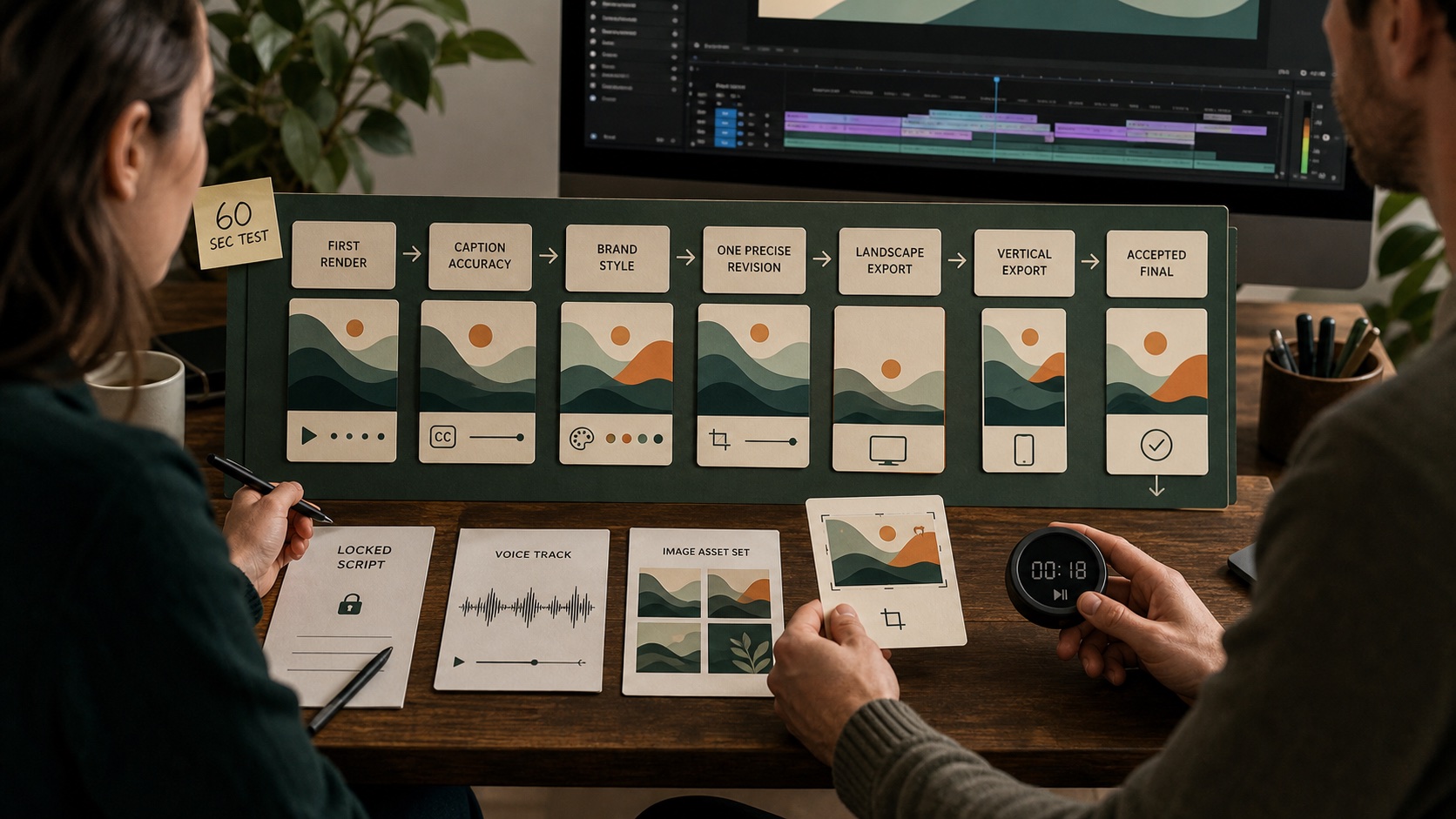
This comparison uses three representative jobs: a 90-second product explainer, a six-minute training module, and a two-minute video derived from an article. Evaluate export quality, revision workflow, metered usage, rights, accessibility, and accepted-minute cost with owned or licensed inputs.
Who This Article Is NOT For
Three groups should close this tab now:
- If you're making cinematic or creative film work — music videos, short films, visually inventive brand spots — this is the wrong category entirely. You want generative video models like Runway, Sora, or Kling, which produce footage rather than presenters. Different tools, different budgets, different (much bigger) consistency problems.
- If you genuinely enjoy editing, none of these will make you happy. They exist to remove the timeline, and you like the timeline. Stay with Premiere Pro, DaVinci Resolve (free, and superb), or CapCut.
- If your content is live — streams, webinars, real-time events — these are all asynchronous production tools. Your money belongs in OBS, StreamYard, or Riverside.
How We Evaluated These Tools (3 Criteria)
1. Demo quality vs. export reality
Do not score a vendor showreel. Supply the same approved script containing names, numbers, and acronyms, then assess pronunciation, pacing, visual relevance, captions, disclosure, and the difference between preview and export.
2. What a minute actually costs
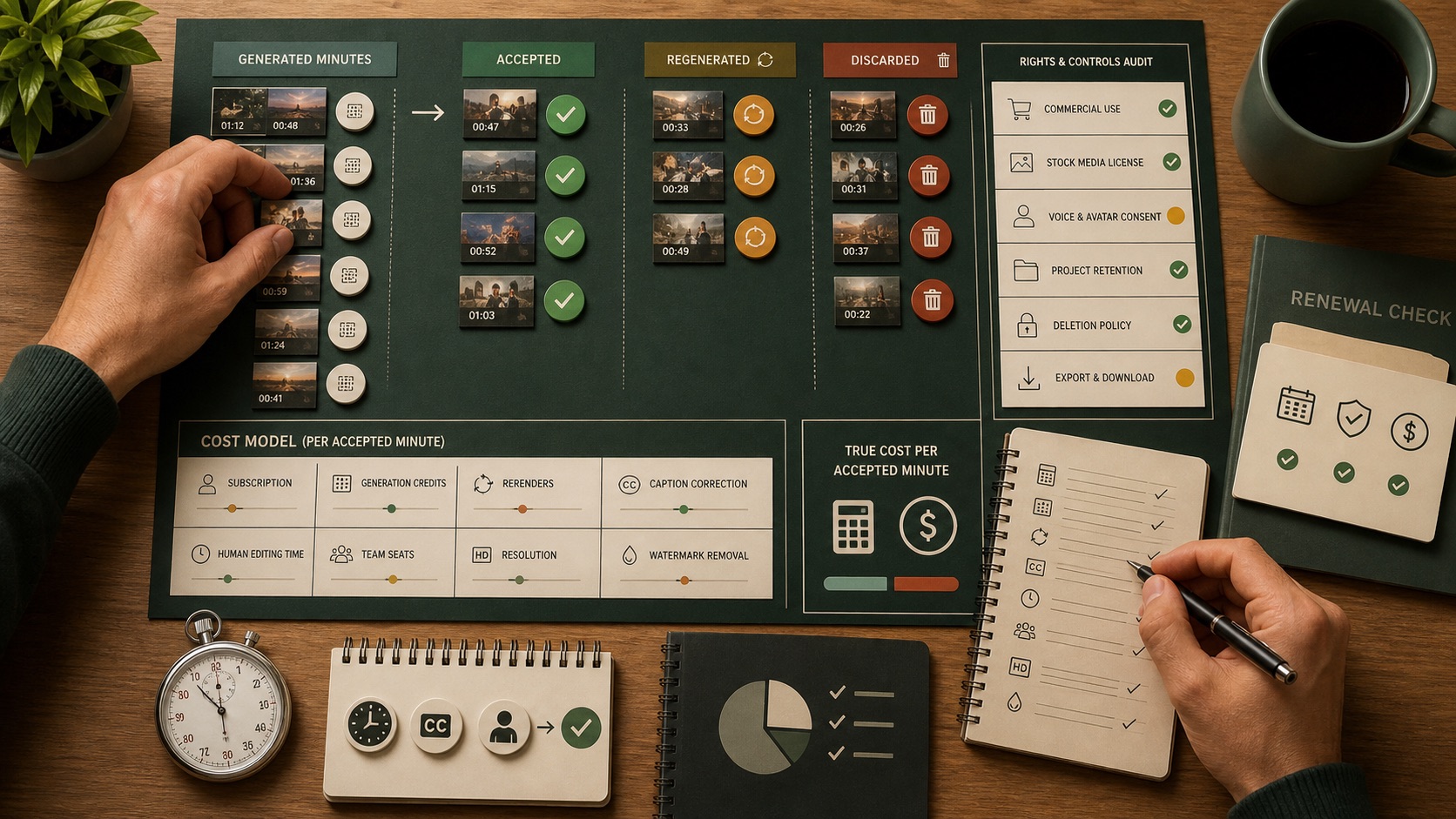
Calculate cost per accepted minute, including discarded generations, revisions, premium avatars, voice or stock add-ons, translation, storage, and human review. A monthly allowance is not the same as usable finished output.
3. Revision speed on real workflows
Time the complete revision loop from an approved script change to reviewed export. Also test templates, brand controls, captions, translations, and whether a correction consumes the same credits as a new generation.
The Comparison Table
Prices are per month on annual billing at the time of writing. This market reprices constantly — confirm on the official pricing pages before you pay.
| Synthesia | HeyGen | InVideo AI | Pictory | Descript | |
|---|---|---|---|---|---|
| Entry paid price | ~$18–29/mo | ~$24–29/mo | ~$20–25/mo | ~$25–29/mo | ~$16–24/mo |
| What that buys | ~10 avatar min/mo | ~credit pool (roughly 10–30 min, avatar-dependent) | ~50 AI min/mo | ~200 video min/mo | ~10 hrs transcription/mo |
| Avatar realism | Very good, corporate-polished | Best in group (Avatar IV) | Serviceable, not the point | None (stock footage) | Your own face (recorded) |
| Personal avatar clone | Yes (higher tiers/paid) | Yes — the headline feature | On upper tiers | No | N/A (you're on camera or voice-only) |
| Languages/translation | 140+ languages | 175+ languages, strong dubbing | 50+ | Voiceover languages, more limited | English-centric AI features |
| Credit/limit gotcha | Minutes don't roll over; overage fees | Premium avatars burn credits ~6× faster | Regenerations eat your minutes | Annual minute pools, AI credits separate | Hour caps + AI credits on some features |
| Free plan | Trial-grade (3 min) | Yes, watermarked | Yes, watermarked | Trial only | Yes (1 hr/mo, watermarked) |
| Demo-vs-export gap | Small — what you see is what you get | Small on avatars, larger on Video Agent | Largest in group | Medium — depends on stock library luck | Small — it's your own footage |
| Best for | Corporate training at scale | Personal-brand and marketing avatars | Cheap prompt-to-social-video | Blog-to-video repurposing | People who'd rather edit text than video |
The Individual Reviews
Synthesia — the corporate training standard, and honest about what that means
Synthesia is the tool your L&D department has already heard of, and there's a reason. It has spent years selling to enterprises, and it shows: SCORM export for learning systems, a structured scene-based editor, brand kits, and avatars in 140+ languages — the number that quietly justifies the whole product, because localizing one training module into nine languages by traditional means costs more than a year of any plan here.
Synthesia emphasizes avatar-led business communication, captions, pronunciation controls, templates, and enterprise localization. Test a representative training script and have subject, accessibility, and brand reviewers approve the export. Avatar acceptability depends on audience, context, disclosure, and brand standards.
Now the honest part: the avatars still read as AI. Improved, yes — hands move now, micro-expressions exist — but ten seconds in, most viewers clock it. For internal training, nobody cares. For customer-facing brand video, I'd hesitate. Synthesia is a communication tool wearing a video tool's clothes, best when the goal is clarity at scale, not charisma.
Synthesia plans meter video usage under current terms. Model the complete monthly training workload, regeneration, languages, collaboration, and any enterprise-only requirement using the official pricing page.
Pros:
- Most consistent script-to-export quality in the group; smallest demo gap
- 140+ languages makes localization absurdly cheap versus traditional production
- Mature enterprise plumbing: SCORM, brand control, a genuinely calm editor
Cons:
- 10 minutes/month on Starter is tight to the point of theater; expect to upgrade
- Avatars remain visibly synthetic — fine for training, risky for brand-facing video
- Best features (translation, priority avatars) gate behind Enterprise conversations
Verdict: Choose Synthesia if you're producing training, onboarding, or internal comms at volume, especially multilingual. It's the safe, governed choice — just budget for the tier above the one you think you need.
HeyGen — the fast-moving challenger with the best avatars
HeyGen markets advanced avatar generation, voice, translation, and prompt-based creation. Compare close-up speech, gestures, pronunciation, disclosure, and identity authorization using controlled inputs; no claim of superior realism is made without displayed evidence.
The headline feature is personal avatar cloning. You record a few minutes of footage, and HeyGen builds a digital twin of you that reads any script — including scripts in languages you don't speak, across 175+ supported languages. For a founder doing weekly product updates, this is the feature that changes the math. My clone was watchable within a day. Not perfect — test viewers spotted it in about half of blind comparisons, usually on emotional emphasis — but dramatically better than the 2024-era clones.
HeyGen credit consumption can differ by model and feature. Record the exact credits used for every draft and accepted export, including discarded takes, voice options, avatars, and add-ons.
Fast product development can also change interfaces and workflows. Confirm current documentation, export behavior, credit rules, and project compatibility before building a repeatable production process.
Pros:
- Best avatar realism available at consumer pricing; personal cloning genuinely works
- 175+ languages with strong lip-synced dubbing — the best translation story here
- Ships new capabilities constantly; the gap to Synthesia's feature set keeps closing
Cons:
- Credit system punishes premium avatars and iteration; effective minutes are far below headline numbers
- Voice clones and additional avatar slots cost extra on lower tiers
- Fast product churn means workflows and UI shift under your feet
Verdict: Choose HeyGen if the avatar itself is the product — personal-brand video, spokesperson content, multilingual marketing. Just do the credit math with premium avatars, not the marketing math.
InVideo AI — prompt-to-video for social, priced for humans
InVideo AI is the only tool here where you can type "make a 60-second video about the top 5 mistakes first-time landlords make, casual tone, male voiceover" and get a complete video — script, stock footage, voiceover, captions, music — in a few minutes. For faceless channels and social teams, that pitch, at around $20–25/month for roughly 50 AI minutes, is the best price-to-output ratio on this list.
InVideo’s prompt-to-video workflow requires supervision of script, footage, facts, branding, captions, and rights. Generate multiple representative topics and record mismatched or generic visuals rather than relying on a polished demo.
Evaluate InVideo as both a draft generator and a finishing workflow. Count human replacements, script edits, fact checks, caption corrections, and total time until the video is publishable.
Watch the meter: regenerations and edits draw from the same monthly AI-minute pool as new videos, so a heavily revised 2-minute video can cost you 10+ minutes of allowance. The Max tier (~$48/month annual) lifts you to about 200 minutes, and a pricier Generative tier meters modern video models at credit rates — that one's a different product with a different budget.
Pros:
- True prompt-to-finished-video; fastest zero-to-draft in the group
- Conversational editing loop makes revisions quick and honestly kind of fun
- Best value for social/faceless content at ~$20–25/month
Cons:
- Stock footage matching is inconsistent — expect to swap clips manually
- AI-written scripts are formulaic; bring your own for anything competitive
- Edits and regenerations consume the same minutes as new generations
Verdict: Choose InVideo AI if you're producing social or faceless-channel volume on a budget and you're willing to supervise the output. Come for the prompt box, stay for the revision loop.
Pictory — the blog-to-video repurposing machine
Pictory focuses on converting supplied text, URLs, scripts, or transcripts into stock-footage videos. Its value should be measured as a repurposing workflow, including summary accuracy, footage relevance, narration, captions, and rights.
Use an owned article with defined key points, then record extraction errors, omitted context, stock replacements, caption corrections, and editing time. Do not publish an automatic summary without source review.
The ceiling is visible early, though. There are no avatars — nobody presents your video. Visual style tops out at "professional stock montage," and your topic determines your luck: my marketing tests matched footage well, while a technical post about database indexing produced clips of... people typing. Lots of people typing. If your niche is visual, Pictory sings. If it's abstract, everything looks like a corporate mood board.
Pricing is friendly by this category's standards. Starter runs about $25–29/month with a pool of video minutes plus separate AI credits for premium voices; Professional (~$35/month annual) is where active users land. The minute pools are generous — hundreds of minutes a month, not tens — but the AI-credit meter for the good voices is the line item to watch.
Pros:
- Fastest honest path from existing text to publishable video
- Generous minute allowances relative to avatar-based competitors
- Editing-by-transcript-outline is genuinely beginner-proof
Cons:
- No avatars and no presenter — stock montage is the ceiling
- Footage matching quality collapses on abstract or technical topics
- Premium AI voices meter separately via credits; the good voices cost extra
Verdict: Choose Pictory if you have a content archive to repurpose and your topics photograph well. It's the least glamorous tool here and possibly the highest ROI per hour of effort.
Descript — the odd one out (and maybe the one you actually need)
Let's be honest: Descript is not an AI video generator. It's a video editor with an AI-first interface, and it's here because a large share of "I need an AI video tool" searches are really "I have footage and I hate editing" problems — and for those, Descript beats everything above.
Descript is primarily an editor with transcription and AI-assisted workflows rather than a pure generative-video system. Test transcript accuracy, text-based edits, filler removal, audio enhancement, captions, and export using footage and voices you are authorized to process. Use several speakers and noise conditions, count incorrect cuts and transcription errors, and require a full human review. Voice cloning or synthesized corrections require explicit authorization and appropriate disclosure.
The demo-vs-export gap is nearly zero here for a structural reason: the output is your own footage, just faster. What you're buying is time. Talking-head edits that took me 50–60 minutes in a traditional editor took 15–20 in Descript.
The limits are equally structural. You must produce source material — yourself, your screen, or a podcast. There's no avatar, no prompt-to-video, no stock-montage engine worth mentioning. The AI features are English-strongest, and pricing has been migrating from simple transcription-hour caps (roughly 10 hours/month on the ~$16–24 Hobbyist tier, more on Creator at ~$24–35) toward a media-hours-plus-AI-credits model — sources conflict on exact caps at the time of writing, so read the plan page closely. The free tier, one hour a month, is a real trial.
Pros:
- Text-based editing is the biggest per-hour time-saver in this article
- Overdub voice correction eliminates the reshoot for flubbed lines
- Near-zero demo gap — your footage, faster
Cons:
- Generates nothing from scratch; you still have to record something
- AI feature set is English-centric compared to Synthesia/HeyGen's localization
- Pricing model in transition — hour caps and AI credits need reading before buying
Verdict: Choose Descript if you (or anyone at your company) can talk into a camera or microphone and the editing was the bottleneck. It produces the most human videos on this list, because they are.
Also on our radar: Vidu, a generation-first tool whose pitch is keeping characters and style consistent across a multi-shot sequence. It makes new creative footage rather than business presenter videos, so it sits outside this comparison; our DomoAI alternatives guide covers where it fits. We are also watching Wizstar, a newer platform aimed at creators and e-commerce sellers that turns product links, images, and ideas into videos, with AI avatars, lip sync, and video translation/localization on its official feature list; we have not yet verified its plan pricing, so check the official page before comparing costs.
Which One Should You Pick? (By Situation)
- "I run L&D and need training modules in multiple languages." → Synthesia. The consistency and localization pipeline are what your compliance team wants, even if the avatars won't win Emmys.
- "I'm the face of my brand but I can't film every week." → HeyGen. Clone yourself once, budget credits honestly, and reclaim your Tuesdays.
- "I run a faceless channel / social accounts and need volume, cheap." → InVideo AI. Supervise the stock footage, bring your own scripts, and the per-video cost is unbeatable.
- "I have 200 blog posts and zero videos." → Pictory. Point it at the archive and publish your backlog.
- "I record podcasts or talking-head videos and editing eats my week." → Descript. It's not a generator, and it will save you more hours than any tool that is.
- "I make one or two simple videos a month." → Keep your money — genuinely. CapCut or DaVinci Resolve free, plus a $0 screen recorder, covers occasional video. These subscriptions earn their keep on volume, and at your volume they won't.
Evidence before purchase
Calculate accepted-video cost, not generated-minute cost
Use scripts, voices, faces, footage, logos, music, and stock assets you own or are authorized to process. Retain the source, settings, disclosures, review notes, rejected generations, accepted export, and license evidence.
| Measure | Evidence | Failure condition |
|---|---|---|
| Script fidelity | Names, numbers, claims, pronunciation, pacing | Meaning changes or unsupported claims appear |
| Visual fit | Scene-by-scene relevance and brand compliance | Generic or misleading imagery remains |
| Accessibility | Caption accuracy, timing, contrast, transcript | Important content is unavailable to target users |
| Revision cost | Credits, minutes, time, discarded renders | Minor corrections consume unpredictable capacity |
| Rights and identity | Licenses, consent, model terms, disclosure | Authorization or permitted use is unclear |
Official resources checked
Verify current credits, minutes, models, avatars, voice rights, stock licensing, storage, exports, watermarks, collaboration, and commercial-use terms.
A note on stylized video: none of the five tools above specialize in transforming existing footage into anime or illustrated styles. If that is your actual need — restyling a clip rather than generating an avatar or assembling stock footage — DomoAI is the specialist worth a trial. It was not part of our test set, so treat this as a pointer, not a verdict.
The Bottom Line
The honest truth about AI video in 2026: the technology crossed the "good enough for business" line, but not the "good enough to stop checking" line. Every tool here still needs a human supervising pronunciation, footage choices, or credit meters. The vendors sell autopilot; what you're buying is a very good copilot. Priced against a freelance editor at $50+ an hour, that's still an excellent deal.
A useful segmentation is avatar-led communication for a synthetic presenter, assembly tools for stock-based content, and transcript-first editors for recorded speakers. Choose by source material and review workflow rather than by the “AI video” label.
Day-one action: take one real script — not a test prompt, an actual piece from your queue — and run it through the free tier or trial of your matched tool above. Time the whole loop, including the take you throw away. Within one afternoon you'll know whether the export, not the demo, earns a line on your card statement. That's the only review that matters more than this one.
Affiliate disclosure: links to Synthesia, HeyGen, InVideo AI, Pictory, and Descript in this article may be affiliate links, meaning we earn a commission if you subscribe through them, at no additional cost to you. Compensation never determines rankings or conclusions — see our editorial policy. Prices and plan limits verified at the time of publication and change frequently; always confirm on the official pricing pages.
Ready to narrow the field?
Use the evidence, then choose for your workflow.
Prices and plans change frequently. Re-check the current offer on the provider’s official website before purchasing. Affiliate links may be added after partner approval and will always be disclosed.
Frequently asked questions
Which AI video tool is best for beginners?
Choose based on the output you need: script-to-video, avatar presentation, short-form editing, or generative clips. Beginners should test one complete project on a free plan and evaluate editing control, export limits, captions, and commercial-use terms.
Can AI-generated videos be used commercially?
Commercial use depends on the provider, plan, source assets, voice rights, and applicable law. Review the current license and keep records for uploaded media, music, fonts, likenesses, and generated assets.
What should I test before paying for an AI video tool?
Create a representative video and check script accuracy, visual consistency, caption correction, brand controls, rendering time, watermark rules, export resolution, and the amount of manual cleanup required.
Fact-checking note: prices and plan terms can change. Verify current details with the provider before purchasing. Last reviewed August 7, 2026.